
camping string lights battery choices matter more than most campers expect, because the wrong power setup leads to harsh glare, short runtimes, and one more dead device before breakfast.
For car campers, tent campers, and van-lifers, string lights work best when they solve a real campsite problem: lighting a table edge, softening a tent entry, or giving you enough ambient glow to cook, sort gear, and move around camp without blasting the whole loop. The sweet spot is not maximum brightness. It is dependable runtime, warm light, easy charging, and a setup you can pack without creating a knot of cable and dead batteries.
Key Takeaways
- Warm white or amber lights are usually better than cool white for preserving night vision and being considerate to nearby campers.
- Rechargeable or USB-powered systems are usually a better long-term value than tiny disposable-battery strands, especially for multi-night trips.
- Runtime matters more than bulb count. A lower setting that lasts all evening is more useful than a bright mode that dies before dishes are done.
- For most campers, string lights should supplement a headlamp or lantern, not replace them.
- Water resistance, charging flexibility, and packability are what separate campsite-friendly lights from patio decor that happens to look outdoorsy.
Table of Contents
Why A Camping String Lights Battery Setup Matters
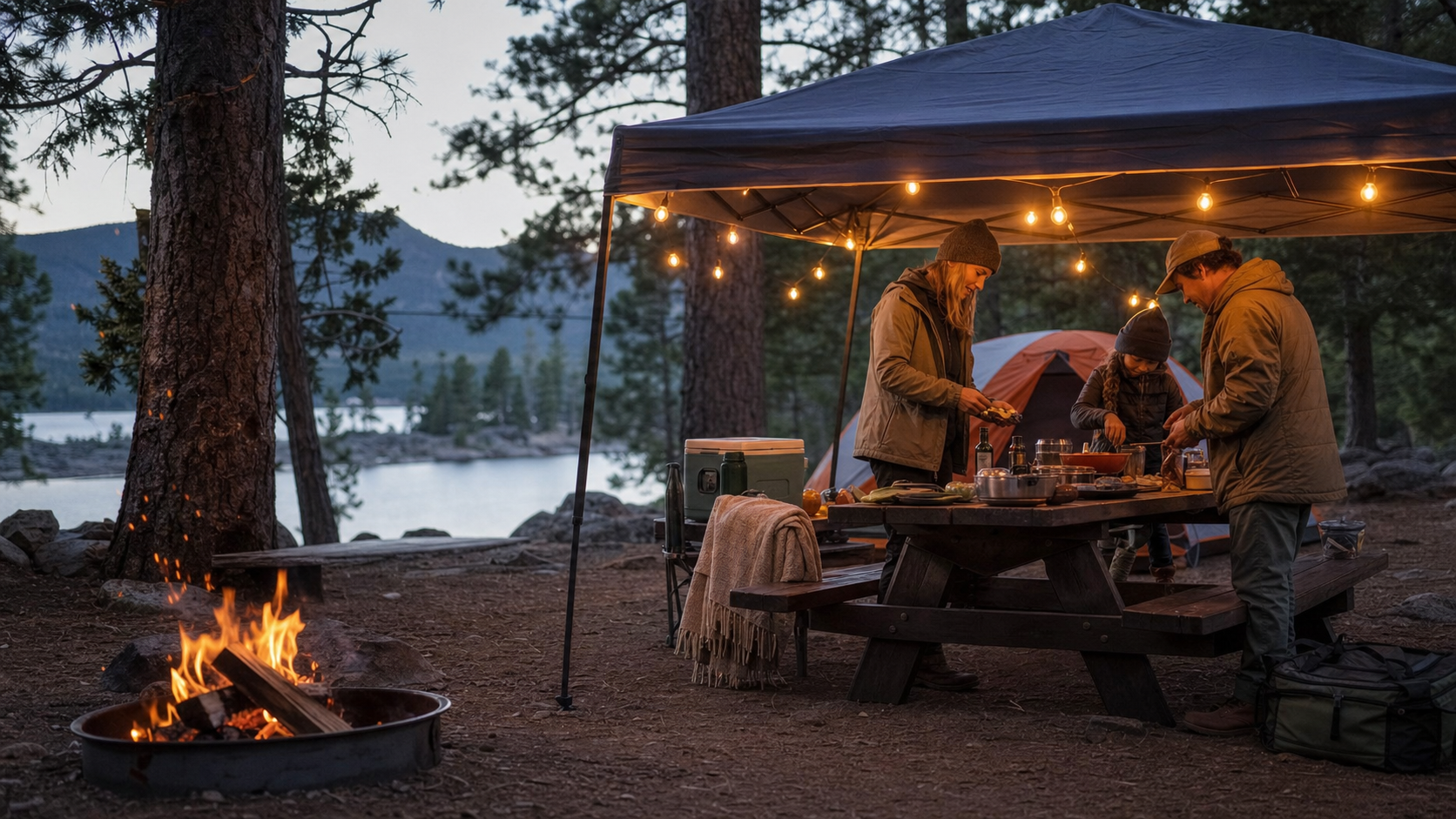
The appeal of string lights is obvious: they spread light gently instead of throwing one hard beam into everybody’s eyes. That is exactly why recent REI lantern testing called out string-light systems as a pleasant way to brighten a camp area. The tradeoff is that ambient light only works when the battery strategy matches the trip. If the pack dies after dinner or needs a wall outlet you do not have, the setup becomes dead weight.
This is also a campsite courtesy issue. The National Park Service camp etiquette guidance recommends keeping lights shielded and pointing down so other people can sleep or enjoy the dark sky. The best setup is the one that gives you enough useful light, in the right place, for the full evening.
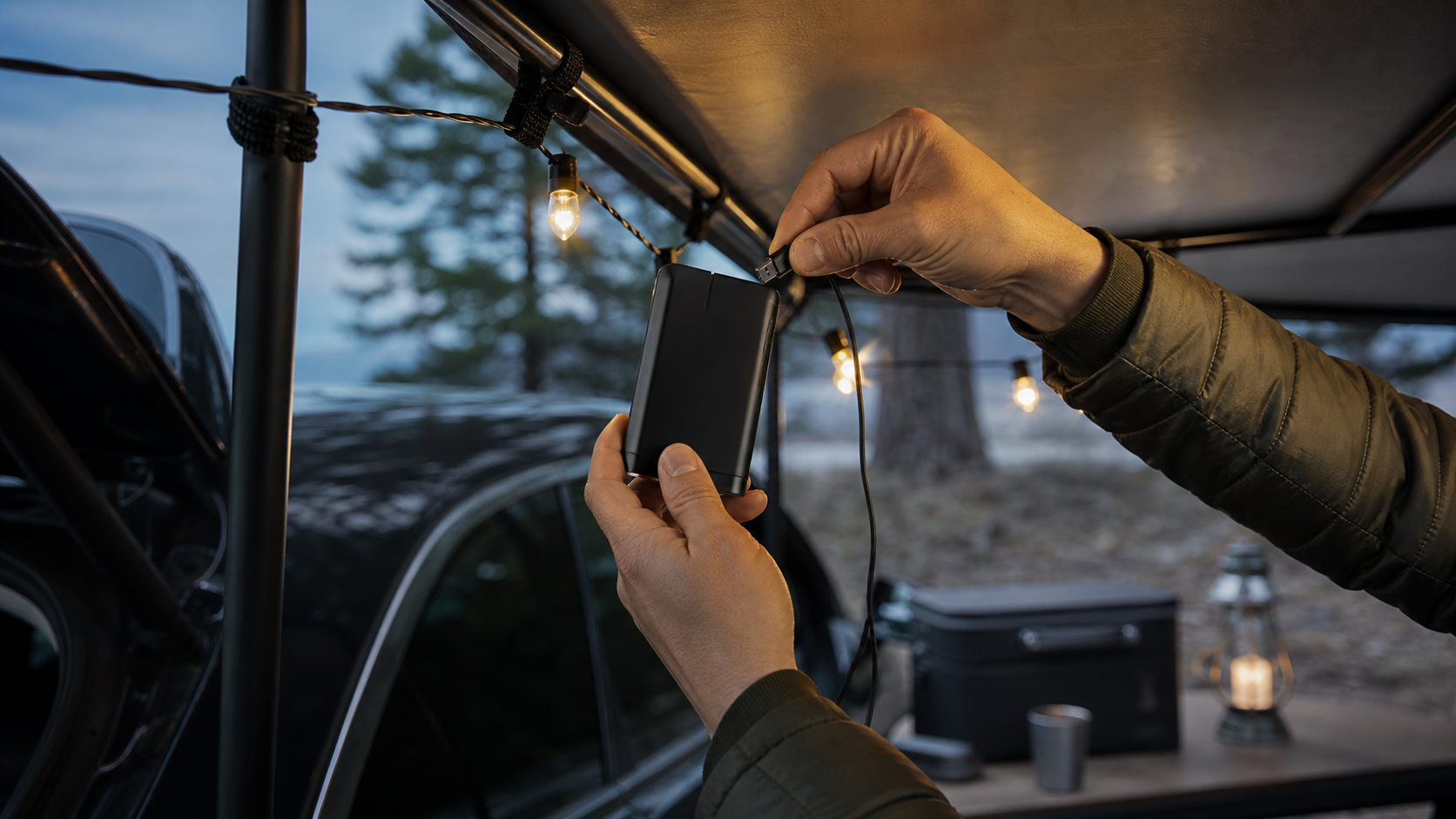
Some campers do best with a rechargeable strand they top off in the car. Others already carry a power bank, so a USB light set makes more sense. Van-life campers may want a longer awning run with a detachable power hub. Backpackers should be cautious, because most campsite string lights are bulkier and less efficient than a good headlamp and lightweight lantern. A good camping string lights battery plan should match the trip length, the rest of your charging kit, and the amount of light you actually need.
Camping String Lights Battery Options Compared
The easiest way to shop is to ignore marketing names and compare the power architecture first. Here is what the most practical categories look like in camp.
| Setup Type | Good Example | Published Runtime | Best For | Main Tradeoff |
|---|---|---|---|---|
| Detachable solar or USB-C hub string lights | BioLite Luci Solar String Lights 18′ | Up to 20 hours on low, about 5 hours on high | Car camping, picnic tables, tent vestibules | Solar top-offs are slower in clouds or shade |
| Longer hub-based string lights | BioLite Luci Solar String Lights 44′ | Up to 40 hours on low, about 8 hours on high | Van awnings, larger basecamps, multi-night use | Bulkier to pack than a short tent strand |
| USB-powered modular light set | Goal Zero Light-A-Life Mini 4-Pack | About 4.5 to 18 hours on a Flip 36 depending on brightness | Campers who already carry power banks | Needs a separate battery source and cable management |
| Lantern plus built-in string light combo | Nite Ize Radiant StarLit | Manufacturer highlights a 23-foot string plus a 200-lumen lantern | Small campsites and family table lighting | Not the cleanest option for longer-distance awning runs |
| Tiny disposable-battery decorative strand | Generic AA or AAA battery pack lights | Too inconsistent to trust without a clear runtime spec | Occasional one-night ambience inside a tent | Usually weakest weather sealing and most battery waste |
For most campers, the safest buy is either a rechargeable strand with USB-C charging or a USB-powered set that can run from a power bank you already own. That keeps your lighting inside the same charging ecosystem as your phone and other camp gadgets.
The standout lesson from current product specs is how dramatically low mode stretches runtime. BioLite’s longer 44-foot system publishes up to 40 hours on low from a detachable 4,000 mAh hub, while Goal Zero’s Light-A-Life approach trades tidiness for flexibility if you already like carrying a power bank or portable power station.
There is also a durability angle here. Separate battery boxes and coin-cell packs are often the first failure point in cheaper strands, especially after rain, dust, or repeated stuffing into a gear bin.
How Bright And Warm Should Campsite Lights Be?
Brightness is where many people overbuy. They imagine needing patio-level lighting when what they actually need is gentle perimeter light around a table, stove, or tent line. Strong overhead light makes a campsite feel exposed, washes out the night sky, and often annoys the people next door.
The best camping string lights battery setups are usually dimmable and comfortable to look at, not just technically bright. That matters more in a real campground than a lumen number on a package.
Leave No Trace’s dark-sky lighting guidance recommends using only the light intensity you need and favoring warm colors such as yellow, amber, or red over white or blue-heavy light. That advice matches real camping use. Warm light feels calmer, preserves your night vision better, and makes it easier to settle down after cooking or hanging out around the table.
A practical rule is to let string lights handle atmosphere and orientation, while a headlamp or lantern handles detail work. If you are chopping vegetables, sorting a tackle box, or looking for a zipper pull, string lights alone are rarely enough.
Placement matters just as much as lumens. Run the strand lower than you think and avoid draping lights high in trees where the glow spills outward. That keeps the light where your hands actually are and follows the NPS advice to shield and direct light down.
Best Setups By Camping Style
Car Camping
Car camping is where string lights make the most sense. Weight is less critical, you can top up from the vehicle if needed, and you probably have a table or canopy worth lighting. A mid-length rechargeable strand or USB-powered set paired with a 10,000 to 20,000 mAh power bank is usually enough. If you already use a portable wireless charger for camping gadgets, check whether your camp lighting can share that same charging routine. For many campers, this is the easiest camping string lights battery approach to live with weekend after weekend.
Tent Camping In Established Campgrounds
In a developed campground, subtlety matters. One short strand around the table edge or vestibule is usually enough. This is also where a layered system works best: string lights for low glare, plus a rechargeable camping lantern for cooking and a rechargeable headlamp for late-night walks to the restroom. That combination is more versatile than trying to solve every lighting problem with one bright strand.
Van Life And Overlanding
This is where longer strings and detachable hubs earn their keep. Awning lighting, tailgate cooking, and gear organization all benefit from broader coverage. If you already rely on a bigger battery system or a solar camping generator, USB-powered strings or longer hub-based lights become much easier to justify. Just watch packing friction: if the light takes too long to untangle, dry, or rewind, you will stop using it.
Backpacking
Backpacking is the least convincing use case. A compact strand can be fun inside a shared shelter or around camp at basecamp, but it rarely beats a headlamp-and-lantern combo on weight, simplicity, or power efficiency. If you still want one, choose the shortest strand you can live with and plan around the same USB battery that charges your phone or inReach. Otherwise, your light becomes an accessory that quietly steals energy from more important gear.
A stable surface such as a foldable camping table also makes it easier to hang a strand low and keep the glow focused where you actually prep food and sort gear.
Common Mistakes And Realistic Downsides
String lights are not a miracle gadget, and the weak points show up fast in camp.
- Buying for style instead of runtime. A beautiful 40-foot strand is useless if it only makes it through dessert at the brightness you actually prefer.
- Ignoring weather protection. Many cheap battery-box lights look fine online but have exposed ports, flimsy covers, or no believable water-resistance claim.
- Choosing cool white light. It feels brighter in the listing, but on a real campsite it is harsher, worse for night vision, and more intrusive to neighbors.
- Using string lights as a task light. You still need a lantern or headlamp for cooking, reading labels, and walking safely after dark.
- Overlighting the site. Campers remember the group with the blinding setup, and not in a good way.
There are realistic downsides even with better systems. Rechargeable strands can be bulkier than you expect, especially once you add a cord and power bank. Solar charging sounds ideal but works best when you actually get direct sun; under heavy trees, USB recharging is usually the plan that saves the trip. Modular USB lights are flexible, but they also create more dangling cable and one more connection to fail in dust or drizzle.
Current roundup testing from GearJunkie’s 2026 camping string lights guide reinforces how different these systems are in brightness, coverage, and battery dependence. Some are really lighting systems. Others are just decorative strands with a campsite photo attached to the box.
A Smart Buying Checklist Before You Order
Use this shortlist before you buy. It keeps the search practical and prevents the most common mistakes. The right camping string lights battery setup should feel easy to recharge, easy to pack, and easy to trust in damp weather.
- Check the claimed runtime on the brightness level you will realistically use, not just the headline maximum.
- Look for warm white, amber, or dimmable output before you chase higher lumen counts.
- Confirm whether the battery is built in, detachable, replaceable, or dependent on a separate USB power bank.
- Verify the charging port. USB-C is usually the easiest choice in 2026 because it reduces cable clutter.
- Make sure the string length matches the job. A 44-foot strand is great for an awning, but silly for a small two-person tent.
- Check the weather story honestly. Water resistance should apply to the power hub or battery pack too, not just the bulbs.
- Think about the rest of your camp system. Lights are easier to live with when they share charging duty with your phone, speaker, and battery bank instead of creating a special-case workflow.
Affiliate disclosure: If you buy through the Amazon links below, we may earn a commission at no extra cost to you.
Helpful Amazon starting points for this category:
- Warm white rechargeable camping string lights for campground-friendly ambient light.
- USB camping string lights for power bank setups if you already charge most gear from USB.
- Battery-powered micro string lights for tent interiors when you only want a short, low-output strand.
- 10,000 mAh USB-C power banks for camping to stretch multi-night runtime without a big power station.
- Dimmable rechargeable camping lanterns if you want a task light to pair with your string setup.
The best buyers do not ask, “What is the brightest string light?” They ask, “What battery system will still be easy after a few damp weekends and rushed pack-outs?”
FAQ
How long do battery-powered camping string lights usually last?
It depends on brightness, battery size, and whether the system uses a detachable hub or a separate power bank. Current rechargeable examples show a wide spread, from roughly 5 hours on higher output to 20 or even 40 hours on lower modes. Always shop the runtime table, not just the marketing photo.
Are camping string lights battery systems good for backpacking?
Usually not. For backpacking, camping string lights battery are more of a luxury than a must-have. A short, lightweight strand can be fun at camp, but a headlamp and compact lantern are usually more efficient and more useful.
Should I choose warm white or cool white lights?
Warm white wins for most campers. It is easier on tired eyes, less disruptive to your night vision, and better aligned with dark-sky courtesy than harsh cool-white light.
Can I run camping string lights from a power bank?
Yes, if the string lights are designed for USB power. This is often one of the cleanest camping string lights battery options for campers who already carry a power bank. Just protect the cable connection from puddles, grit, and tripping feet.
Do string lights replace a lantern or headlamp?
No. They are best for ambient light and campsite orientation. You still want a lantern or headlamp for cooking, finding gear, and safe movement after dark.
Final Word
A good camping string lights battery setup should feel quiet, useful, and easy to live with. For most campers, that means warm light, honest runtime, simple charging, and enough weather resistance to survive a damp night.