
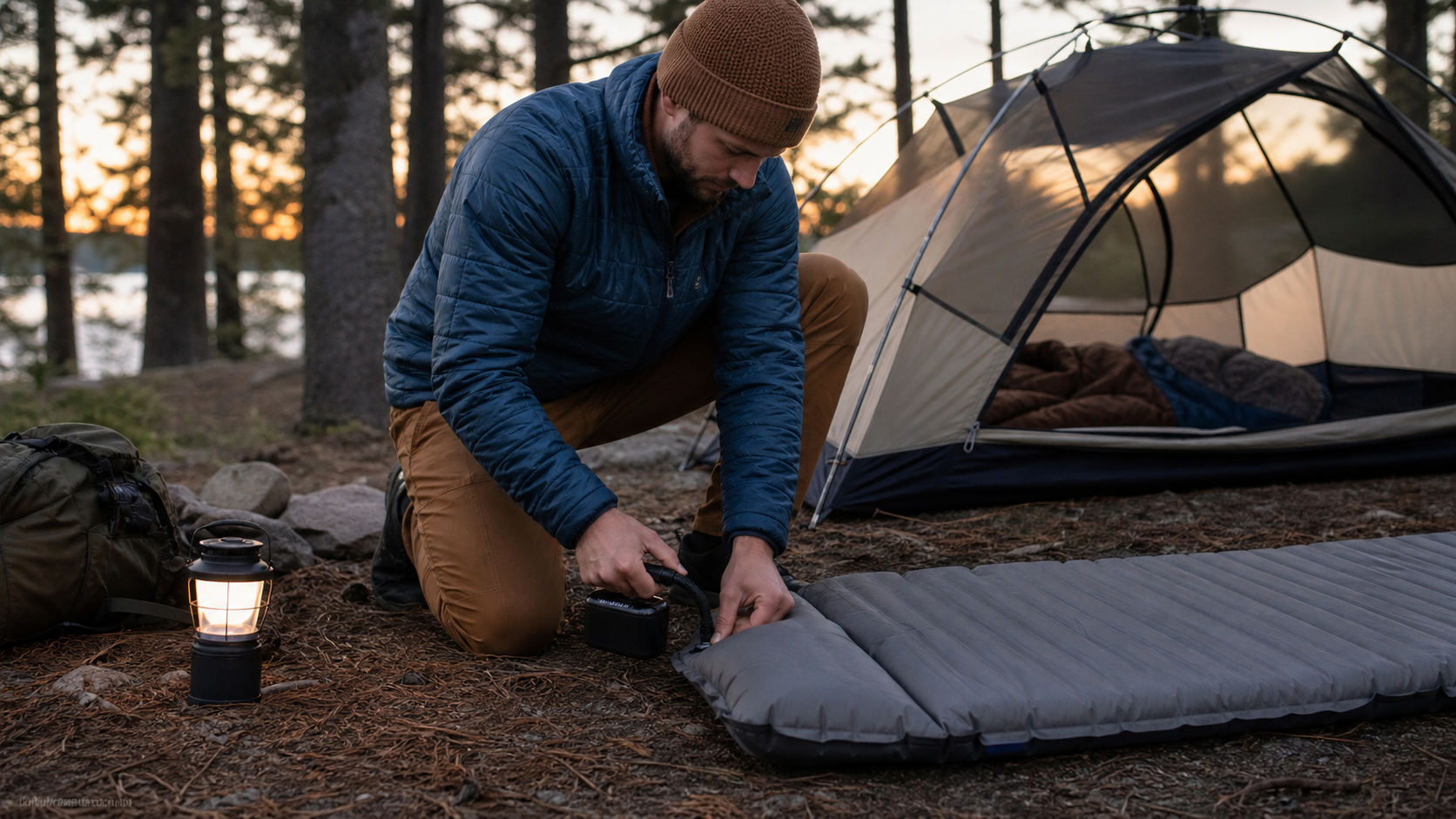
rechargeable air pump camping sounds like a small upgrade, but the right pump can cut bedtime setup, keep moisture out of your sleeping pad, and make pack-up much less annoying when the campsite is wet, sandy, or already dark.
Key Takeaways
- Pad valve compatibility matters more than raw pump power. A fast pump that does not seal well is a frustrating pump.
- Backpackers usually want low weight and enough battery for one or two pads, while car campers benefit more from stronger airflow and deflate mode.
- Rechargeable pumps help reduce moist breath inside air pads, which can be better for long-term pad care when you still dry the pad properly at home.
- USB-C charging, realistic runtime, and campsite noise are the specs that affect real trips most.
- The best buy is rarely the biggest pump. It is the one you will actually pack, recharge, and use without adapters falling off in the dark.
Table of Contents
- Why campers use a rechargeable pump at all
- Check 1: Valve compatibility first
- Check 2: Airflow and pressure in the real world
- Check 3: Battery and charging reality
- Check 4: Moisture and sleeping pad care
- Check 5: Campsite usability and pack-down
- Common buying mistakes to avoid
- Helpful Amazon searches
- FAQ
Why Campers Use a Rechargeable Pump At All
A rechargeable pump is not essential for every trip. If you camp a few weekends per year with a self-inflating pad, the included pump sack may already do enough. But if you regularly inflate thicker car-camping pads, shared family mattresses, inflatable loungers, or van-life guest beds, a small powered pump removes one of the most repetitive chores in camp.
The practical upside is not just speed. Powered inflation is easier when your hands are cold, when the ground is muddy, or when you are arriving after sunset and want your sleep setup done quickly. It also helps if you are already carrying other rechargeable camp gear like a rechargeable camping fan or dialing in a bigger power plan with folding solar panel camping gear.
The realistic downside is that this is one more battery-powered item to charge, protect, and remember. That is why the smartest way to shop is not “Which pump is strongest?” It is “Which pump best matches my pad, my campsite routine, and my tolerance for extra gear?”
Check 1: Valve Compatibility First
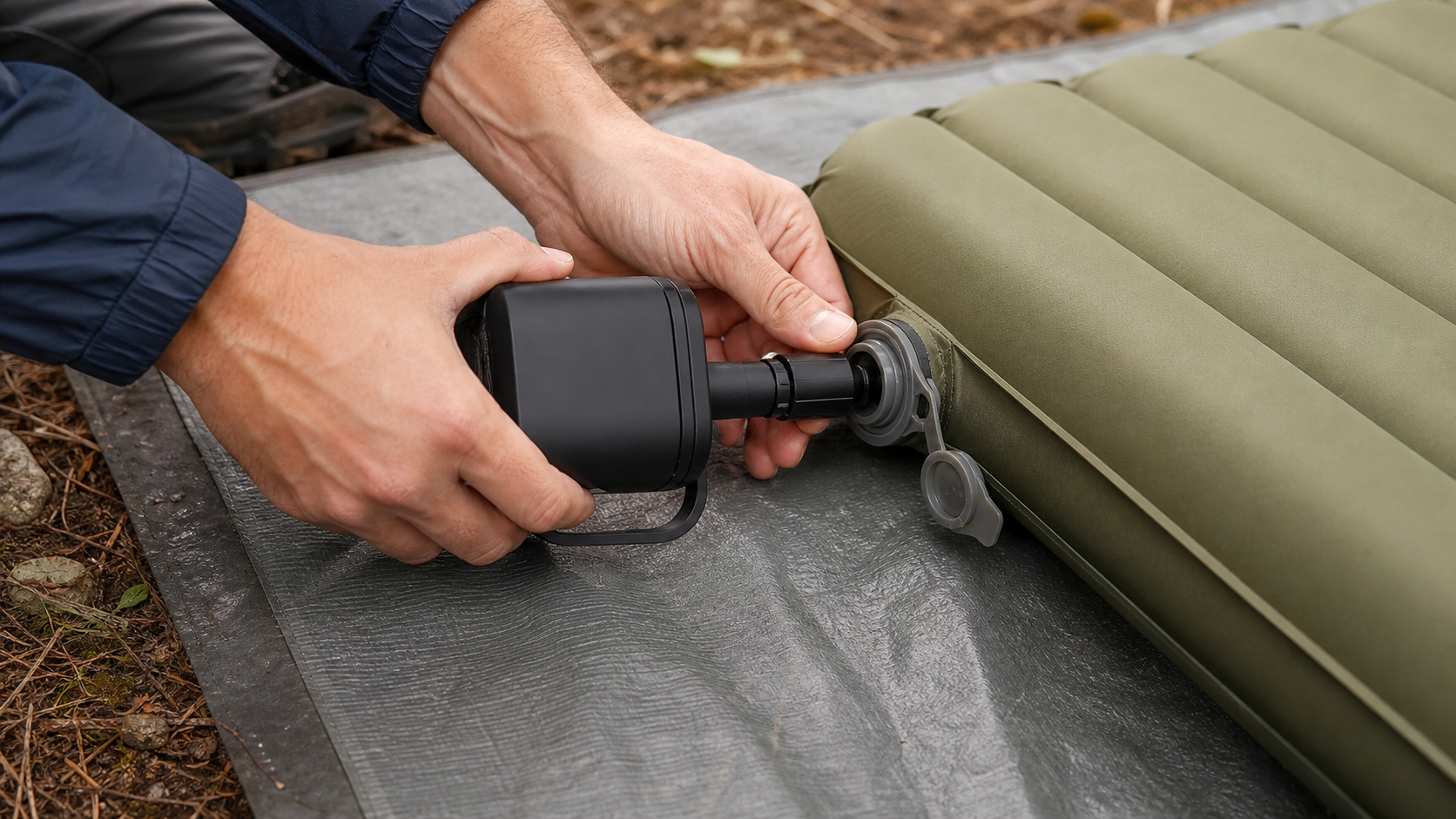
If a pump does not fit your pad cleanly, nothing else matters. Campsite frustration usually starts with adapters that pop off, leak, or require two hands to hold in place while the pad fills. Before buying, check the exact valve style on your mattress and confirm whether the pump includes the right adapter out of the box.
Do not assume “universal” means truly universal
Exped’s Ultra Pump explicitly notes that it includes adapters for Exped mats and many other inflatables, which is useful if you own mixed-brand gear. That is the kind of wording you want to see. By contrast, some pump sacks and pad-specific inflators work beautifully within one brand family and become annoying outside it.
That brand-specific limitation matters more than many buyers expect. If your household has one backpacking pad, one thick self-inflating bed, and an inflatable camping tent or lounge, a tiny specialist pump can end up serving only one item. A slightly heavier pump with better adapter coverage often delivers more value over a full season.
This is also where internal planning helps. If your camp style already leans toward faster setup systems like an inflatable camping tent, it makes sense to choose accessories that reduce setup friction instead of adding more fiddly parts.
Check 2: Airflow and Pressure in the Real World
Airflow fills volume. Pressure finishes firmness. For camping pads, you usually need both, but not in equal amounts. A low-volume backpacking pad can fill quickly with a small pump. A thick car-camping mattress or wide double pad needs more airflow to avoid a slow, whiny wait. At the same time, many pumps still leave a pad slightly soft, so you may need a final manual top-off depending on the valve and mattress design.
That is why raw marketing numbers can mislead. A very small pump may be light enough for backpacking, yet still feel underpowered on a big base-camp mattress. A stronger pump may be ideal for thicker sleep systems, but overkill if your goal is shaving a few ounces from a backcountry kit.
| Pump Type | Example | Best For | Why It Works | Tradeoff |
|---|---|---|---|---|
| Pump sack | Sea to Summit Air Stream | Backpacking pads | Very light, no battery, doubles as storage, and Sea to Summit says two to three cycles can inflate many pads. | Not hands-free and slower on large mattresses |
| Micro rechargeable pump | Flextail Zero Pump | Ultralight campers | Extremely packable and light enough to justify bringing on shorter trips | Less margin for big pads and repeated inflation jobs |
| Balanced all-around pump | Exped Ultra Pump | Solo campers who want low weight plus convenience | 100 g weight, USB-C charging, and enough runtime for repeated pad fills | Still another battery item to manage |
| Higher-output camp pump | Flextail Max Pump 3 | Car camping and thicker inflatables | More airflow and pressure are useful when the sleep setup is larger and comfort-focused | Bigger than true minimalist options |
Check 3: Battery and Charging Reality
This is where many otherwise good pumps get sorted into “useful” and “left at home.” A camping pump should charge the same way your other field electronics charge, ideally over USB-C, and it should provide enough runtime that you are not guarding every inflation cycle. Exped lists a 1600 mAh battery and about 25 minutes of runtime on the Ultra Pump, which is enough detail to estimate whether one charge covers a weekend.
If you mostly camp from a car, battery management is simple. If you backpack, paddle, or fly to trailheads, battery logistics matter more. The FAA’s battery guidance is worth a quick read because spare lithium batteries belong in carry-on baggage, not checked luggage. For fly-drive trips, that alone can shape whether you prefer a rechargeable pump or a no-battery pump sack.
On longer trips, a pump becomes easier to justify when it fits the rest of your charging ecosystem. If you already rely on a portable wireless charger, a compact 30W portable charger, or a larger solar camping generator, keeping one more small USB device topped off is not a big deal. If your power plan is weak, a pump sack stays appealing because it works every time without needing charge discipline.
Check 4: Moisture and Sleeping Pad Care
One of the strongest arguments for a rechargeable pad pump is not comfort. It is moisture control. Moist breath inside an air pad is not instantly catastrophic, but over time it can contribute to mildew risk and make long-term storage less ideal.
NEMO’s support guidance is direct on this point: condensation from your breath enters the pad, and using a pump sack helps reduce how much moisture goes inside. Sea to Summit makes a similar case, noting that its Air Stream pump inflates many pads in two to three cycles with minimal condensation.
A rechargeable air pump camping setup helps for the same reason. You are moving outside air through the mattress instead of huffing warm breath directly into it. That said, this is not a magic shield. NEMO also recommends air-drying pads with valves open and storing them flat or loosely rolled in a cool, dry place.
If you camp in humid climates, on beach trips, or during rainy shoulder seasons, this check matters even more. The more often your pad sees damp conditions, the more worthwhile it is to reduce extra internal moisture whenever you can.
Check 5: Campsite Usability and Pack-Down
The final buying check is the one that decides whether you keep using the pump after the novelty wears off. Does it work one-handed? Can you see the button layout in the dark? Does it have a hang loop or built-in light? Can it also deflate a big pad enough that rolling and packing becomes easier?
For backpackers, simplicity usually wins. A tiny pump that clips into a ditty bag and inflates one sleeping pad quickly can be enough. For family camps or thicker mattresses, deflate mode is often the bigger luxury.
Noise also deserves more attention than most shoppers give it. Small high-speed fans can sound sharp in a quiet campground, even if they run for less than a minute. My rule is simple: if you expect to inflate pads after quiet hours, use the pump early or pick a manual sack. Good campsite etiquette matters just as much as gadget convenience.
This is why I would rather buy a slightly slower pump that packs small, seals well, and feels easy to use than a supposedly powerful one that needs constant fiddling.
Common Buying Mistakes to Avoid
The biggest mistake is buying for the wrong sleep system. A micro pump can be brilliant for a lightweight backpacking pad and underwhelming for a tall double mattress. The second mistake is ignoring adapters until the product arrives. The third is trusting battery runtime claims without considering cold weather, partial charges, or thicker mattresses.
Another common miss is paying for bonus features you will never use. A built-in lantern is handy for some campers and dead weight for others. Also do not ignore the downsides: rechargeable pumps can fail if forgotten uncharged, tiny nozzles are easy to lose, and heavier pumps can feel silly on trips where a simple pump sack would have done the job.
Helpful Amazon Searches
Affiliate disclosure: If you buy through links below, we may earn a commission at no extra cost to you.
- Rechargeable sleeping pad pump
- Ultralight camping air pump
- USB-C air mattress pump for camping
- Camping pump with deflate mode
- Flat valve adapter camping air pump
FAQ
Is a rechargeable pump better than a pump sack for camping?
It depends on your trip style. A pump sack is lighter and never needs charging, so it stays excellent for backpacking. A rechargeable pump is better when you inflate thicker pads, multiple mattresses, or want faster pack-up with deflate mode.
Can a rechargeable camping pump fully inflate a sleeping pad without finishing by mouth?
Sometimes yes, but not always. Many pumps get a pad most of the way there, while some sleepers still prefer a tiny final top-off for firmness.
Do rechargeable pumps help protect sleeping pads?
They can help by reducing how much humid breath goes inside the pad. That benefit is real, but you still need to dry the pad properly and store it with the valves open when the manufacturer recommends it.
What is the best rechargeable air pump camping choice for most campers?
For most campers, the best choice is the lightest pump that matches your valve type, charges over USB-C, and has enough runtime for your actual sleep setup. Compatibility and campsite usability are more important than chasing the biggest spec numbers.
If your goal is better camp comfort without overpacking, a rechargeable pump earns its place only when it removes real friction. Match it to your pad, your power setup, and your campsite habits, and it becomes a small upgrade that keeps proving useful.
Related reading: if you are building a more comfortable sleep-and-power setup, these guides pair well with this topic: Rechargeable Camping Fan, Folding Solar Panel Camping, Solar Camping Generator, Portable Wireless Charger, and Inflatable Camping Tent.