
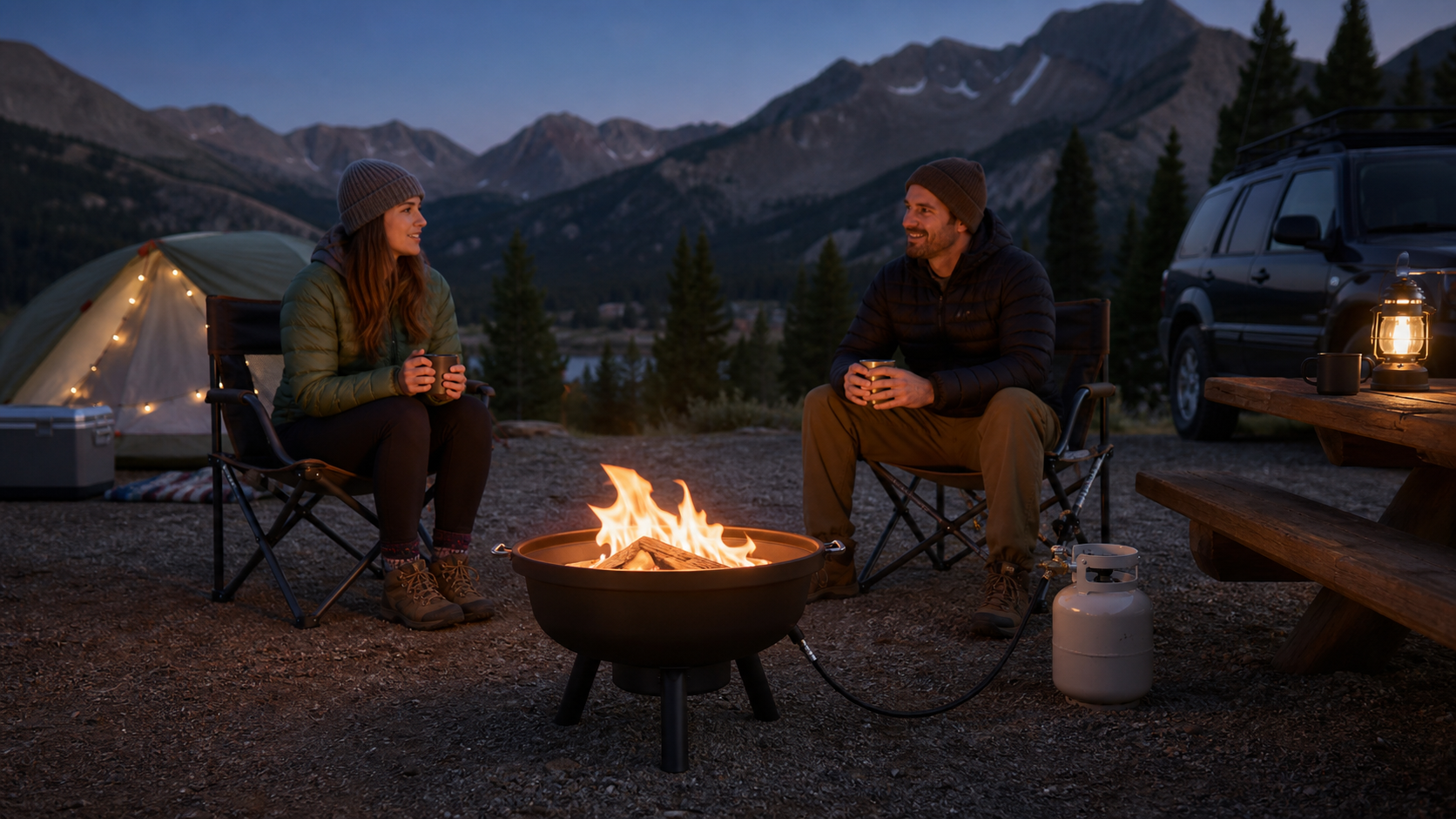
portable propane fire pit camping makes cold evenings easier when wood fires are smoky, restricted, or just too messy for the kind of campsite comfort most car campers actually want.
A good propane fire pit gives you faster setup, less lingering smoke in jackets and bedding, and a cleaner shutdown before bed. The catch is that campers still need to check local rules, choose the right size, and pack the right tank, hose, and ground protection. This guide focuses on those practical decisions so you buy once and avoid the common mistakes that make portable fire pits feel bulky, weak, or not worth the space.
Key Takeaways
- Portable propane fire pits are cleaner and faster than wood, but they are not automatically allowed during every burn restriction.
- The best camping setup balances bowl size, BTU output, tank choice, wind performance, and how much cargo room you can spare.
- A 5 lb or 20 lb tank is usually more realistic than disposable cylinders for repeated weekend use.
- Surface protection, hose routing, and safe chair spacing matter just as much as flame height.
- The smartest buy is the one you will actually pack, set up, and shut down without creating extra campsite hassle.
Table of Contents
Why Campers Switch to Propane Fire Pits
The biggest reason campers move to propane is predictability. You skip wet firewood, smoky clothes, ash cleanup, and the long wait for coals to cool. That matters on quick weekend trips, windy beach camps, family campgrounds, and vehicle-based setups where people want warmth and atmosphere without building the evening around a wood fire.
For many vehicle-based campers, portable propane fire pit camping is the easiest way to keep evenings comfortable without the full wood-fire routine.
There is also a real rules angle. The National Park Service recommends checking both local fire rules and current conditions before lighting any campfire because restrictions can change with wind and drought. Some forests still allow propane appliances with shut-off valves during Stage 1 restrictions, while others narrow where and how they can be used. For example, NPS campfire guidance emphasizes knowing local rules first, the Lincoln National Forest Stage 1 order allows propane devices in cleared areas, and Inyo National Forest allows certain portable gas fire pits outside developed sites when the required conditions are met.
That flexibility is the real appeal of camping propane fire pit setups, but it comes with a warning: never assume “propane” means “always allowed.” A good buyer plans around the strictest campground or public-land rule they are likely to face, not the best-case scenario.
Affiliate disclosure: We may earn a small commission from helpful gear links below, at no extra cost to you.
6 Essential Checks Before You Buy
These six checks make portable propane fire pit camping safer, easier to pack, and much more satisfying once the sun goes down.
1. Confirm the exact fire rule where you camp most
This is the check that saves the most frustration. If your trips are mostly in developed campgrounds, a portable propane fire pit can be a straightforward comfort upgrade. If you do more dispersed camping, national forest travel, or shoulder-season trips during dry weather, the rule picture is more complicated.
In 2025, the Rogue River-Siskiyou National Forest noted that some Stage 1 public use restrictions still allowed propane fire pits outside designated campgrounds, but that is not universal. Weather alerts matter too. The National Weather Service explains that a Fire Weather Watch or Red Flag Warning signals dry, windy conditions when campers should expect tighter rules or more cautious campground enforcement. If you regularly travel in the West or Southwest, this one check can matter more than price, flame size, or brand.
Practical takeaway: before you buy, think about where you go most often. If those trips commonly involve strict burn rules, prioritize a propane model with a shut-off valve, a stable base, and simple documentation that clearly identifies it as a propane campfire device rather than a decorative patio fire bowl.
2. Match the fire pit size to your seating circle, not your backyard fantasy
Many campers overbuy here. A giant bowl looks great online, but it eats cargo space and rarely delivers enough extra usable warmth to justify the size in a normal two-to-four-person campsite. A compact 19-inch to 20-inch model is often enough for a pair of chairs and a small side table, while wider bowls make more sense for family camps or group sites.
BTU numbers help, but only up to a point. Around 50,000 to 65,000 BTU is common for camping-friendly propane fire pits, which is usually plenty for shoulder-season warmth at close range. The better question is whether the flame feels useful in wind and whether the unit still fits in your vehicle next to coolers, bins, and bedding.
If you are still comparing shapes and sizes, start with a broad search for portable propane fire pit camping options and focus on diameter, packed height, and total carry weight before you obsess over cosmetic finishes.
3. Choose a realistic tank and fuel setup
A portable propane fire pit is only convenient if the fuel setup is convenient too. Disposable one-pound cylinders look simple, but they burn through quickly on high flame and become annoying for repeated weekends. The National Park Service also warns that non-refillable DOT-39 cylinders should never be refilled and points campers toward proper disposal or certified refillable alternatives in its propane canister safety guidance.
For most campers, there are three realistic paths:
- One-pound cylinders for occasional short evenings and minimal weight.
- A 5 lb tank for better portability and noticeably longer runtime.
- A standard 20 lb tank for basecamp, RV, and group trips where runtime matters more than carry convenience.
The sweet spot for many car campers is a 5 lb propane tank with gauge. It packs more cleanly than a 20 lb cylinder but avoids the disposable-cylinder churn that makes portable fire pits feel wasteful. If you already carry several propane accessories, a propane tank level gauge is a cheap sanity check that prevents the classic “fire pit dies right after dinner” moment.
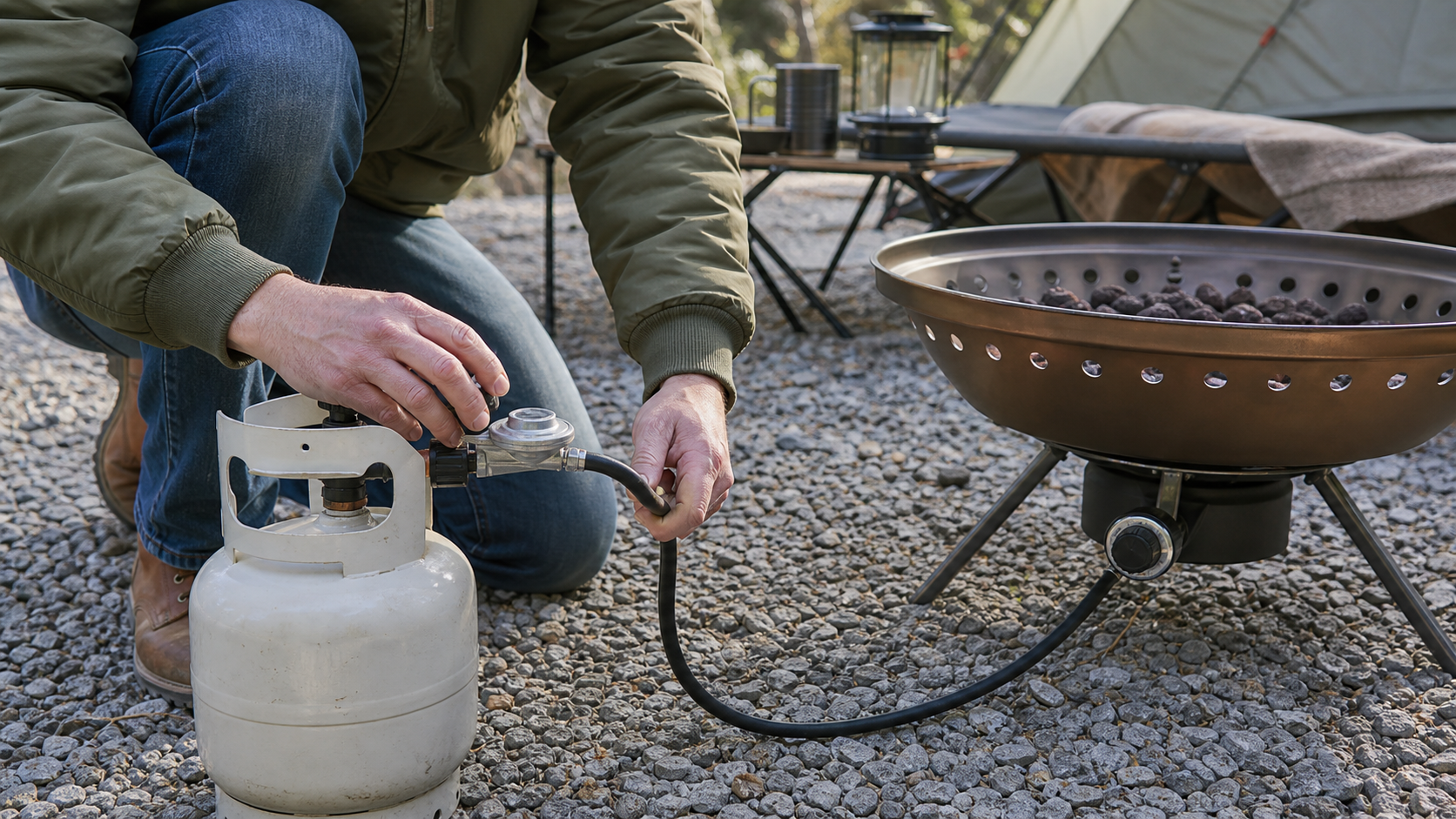
Also check hose length. A longer hose helps keep the tank farther from foot traffic and chair legs, but only if it stores cleanly and does not create a tripping line across the site.
4. Protect the ground and leave enough breathing room
Wood-fire rules around spark distance do not translate perfectly to propane, but the layout mindset still matters. Keep enough room for chairs, coolers, dog leashes, and nighttime bathroom trips. Tight campsites make even a tidy propane flame feel awkward if the fire pit ends up in the only walkway.
Some campgrounds allow portable propane fire pits only on durable surfaces like gravel or established pads. Others care more about overall fire conditions than the exact surface. Either way, it is smart to carry a propane fire pit mat when you camp on delicate pads, composite RV decks, or places where heat discoloration would be a problem. It also makes your setup look more intentional instead of improvised.
A good rule of thumb is to set the bowl where people can warm hands comfortably without anyone backing a chair into the hose. If the site is windy enough that the flame pattern is blowing hard to one side, you will often get more comfort by repositioning the bowl and chairs than by turning the flame higher.
5. Be honest about the tradeoffs
Portable propane fire pits solve real problems, but they do not recreate every part of a wood fire. The warmth is usually more directional and less lingering. You hear some gas hiss. Most models are not ideal for direct cooking. And if your campsite neighbors expect a roaring visual centerpiece, a compact propane bowl can feel underwhelming.
This is why the best buyers think in use cases:
- For late-arrival campgrounds, propane wins on speed and cleanup.
- For smoky beach or desert sites, propane wins on comfort.
- For social fires with big seating circles, a small bowl often feels too weak.
- For windy ridgelines, any fire pit can be disappointing without smart placement.
The real mistake is expecting one product to cover every season, every campsite, and every group size. For most couples camping, van-life overnights, and family campground weekends, a moderate-size model is the most satisfying compromise.
6. Pack for setup, shutdown, and storage
The best portable propane fire pit camping setup is the one that disappears into your routine. That means it should unload fast, light easily, cool down predictably, and pack away without coating other gear in soot or loose rock. Even good models feel annoying when the lid rattles, lava rocks spill into storage bins, or the hose tangles around the regulator every trip.
A dedicated propane fire pit carry bag helps more than most people expect, especially if you are already organizing camp furniture, lighting, and kitchen boxes in separate vehicle bins. It turns a loose awkward item into one more manageable module.
Shutdown habits matter too. Let the unit cool fully, brush out dust and grit before storage, and keep the hose threads clean. A little maintenance goes a long way toward avoiding regulator issues and burner corrosion.
Portable Propane Fire Pit Camping: Which Style Fits Your Campsite Best
If you are still deciding between form factors, use this table to narrow the field based on real campsite behavior instead of marketing photos.
| Style | Best For | Typical BTU Band | Packability | Main Drawback |
|---|---|---|---|---|
| Compact round bowl | Two campers, quick weekends, small SUVs | Around 50,000 to 58,000 | Easy to slide into a gear stack | Can feel small for bigger seating circles |
| Enclosed fire-can style | Windier camps, cleaner transport, tighter storage systems | Around 50,000 to 55,000 | Very tidy and easy to carry | Less open-fire feel and narrower heat spread |
| Wider group-size bowl | Family campgrounds and longer evening hangouts | Around 58,000 to 65,000 | Bulky in smaller vehicles | Harder to justify if you camp with only one or two people |
My practical bias: most campers are happier sizing down one step and spending the saved space on better chairs, warmer blankets, or more useful campsite lighting.
To round out the rest of the site, pair your fire setup with a foldable camping furniture guide, better night lighting from our rechargeable camping lantern and camping string lights battery guides, easier cleanup with a portable hand washing station camping setup, smarter water storage from our collapsible water container camping guide, and faster food organization with a camp kitchen organizer.
Common Buying Mistakes
Most frustrations with portable propane fire pit camping come from a few repeat mistakes:
- Buying by BTU alone and ignoring pack size.
- Assuming every burn restriction still allows propane campfires.
- Relying on one-pound cylinders for long evenings with multiple nights of use.
- Skipping a mat or durable surface plan on sensitive campsites.
- Placing the pit where people must step over the hose after dark.
- Expecting a small bowl to warm a big group spread across a wide site.
If you avoid those six mistakes, portable propane fire pit camping usually feels like a genuine comfort upgrade instead of one more gadget fighting for cargo room.
That is where portable propane fire pit camping stops feeling like a novelty and starts becoming a repeat part of a comfortable campsite routine.
FAQ
These are the questions campers ask most often when portable propane fire pit camping moves from idea to actual gear purchase.
Are portable propane fire pits allowed during fire bans?
Sometimes, but not always. Some forests allow propane fire pits with shut-off valves during Stage 1 restrictions when used on cleared ground, while stricter conditions or specific campground rules may still ban them. Always check the exact agency or campground rule for your destination before the trip.
What size propane tank works best for camping?
For most car campers, a 5 lb tank is the best balance of runtime and portability. A 20 lb tank makes sense for RVs, group sites, and long weekends, while one-pound cylinders are better for occasional short use than for regular campfire duty.
Do propane fire pits give off enough heat on cold nights?
They help most when chairs are kept fairly close and wind is manageable. They usually feel warmer than sitting without a fire, but they rarely match the broad radiant heat of a strong wood fire for larger groups.
Can you cook over a camping propane fire pit?
Some campers warm food nearby or use accessories, but most portable propane fire pits are better treated as warmth-and-ambience gear than as a primary cooking system. A dedicated stove or grill remains the easier choice for reliable camp meals.
What is the most overlooked accessory?
A stable fuel setup is first, but a carry bag or storage tote is the sleeper upgrade. It keeps lava rock, dust, and hose clutter from spreading through the rest of your camp gear and makes packing out much faster.
Conclusion
Portable propane fire pit camping is worth it when you want cleaner evenings, quicker setup, and a better shot at staying within campground fire rules. The smartest way to buy is to focus on six checks: local restrictions, realistic size, practical fuel choice, ground protection, honest tradeoffs, and easy storage. Get those right and you end up with a fire setup you will actually bring on trips instead of leaving in the garage.
If your camping style leans toward car camping, van-life comfort, and organized basecamp evenings, portable propane fire pit camping works best with a mid-size model and a stable tank plan you will actually reuse trip after trip.